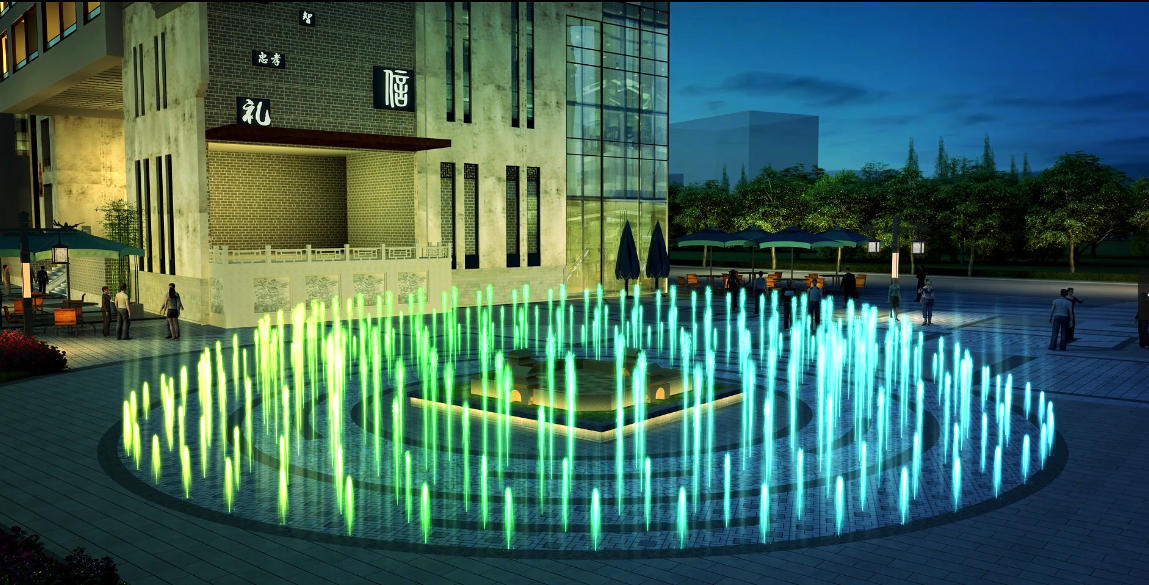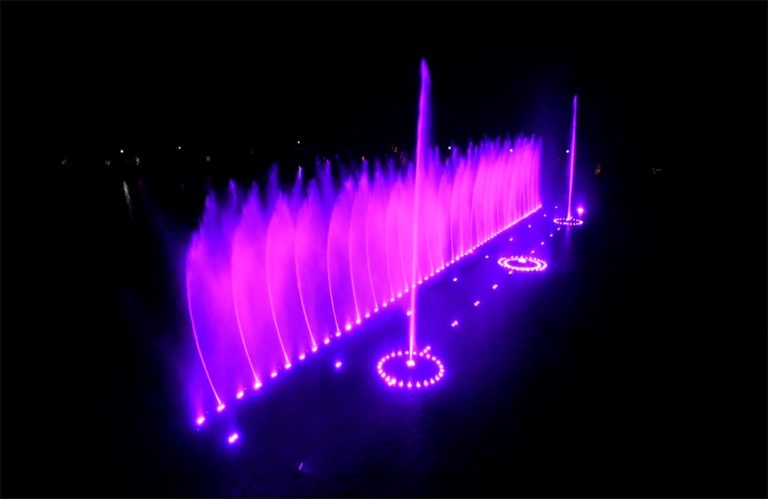
Square Fountain Design
After 15 years in the fountain business, here is what we have learned: the difference between a plaza that draws crowds every evening and one that sits dead is almost always decided at the design stage. Not the budget stage.
Walk through any city plaza at dusk and you will notice a pattern. The spot where people gather, linger, take photos, and bring their kids? It is almost never the sculpture garden. It is the fountain. A well-designed musical fountain turns a concrete square into a living room for the city. But that kind of magnetic pull is not an accident. It is engineered.
This article is not theory. It is what we have seen across 1000+ projects, distilled into the six design decisions that actually determine whether a plaza fountain works — or becomes an expensive wet patch nobody visits.
1、 Water Choreography Is About Contrast, Not Volume
A common request from first-time clients: “Make it grand.” In design terms, that does not mean shooting water higher. It means layering.
Effective plaza fountain choreography follows a three-tier structure:
- Primary gesture that anchors the space — a tall central jet or a sweeping arch that defines the visual center
- Mid-layer of secondary effects that create depth — fan sprays, rotating nozzles, cascading curtains
- Ambient elements at ground level — jumping jets, mist nozzles, bubbling springs that invite interaction
These three tiers need meaningful height separation and tempo contrast between them. If everything fires at the same height, the eye flattens the scene into a white blur. The audience loses interest in 30 seconds.
Lesson from the field: A plaza fountain is not a theater show. People walk around it, stand close to it, watch it from multiple angles. Good choreography holds attention for 10 minutes, not 10 seconds. It rewards repeat viewing. That is a rhythm question, not an equipment question.
2、 The Control System Is the Show
There is a saying in this industry: hardware sets the floor, control sets the ceiling. The best pumps and nozzles in the world will not dance if the brain behind them cannot keep time.
| Dimension | DMX Control System | Legacy PLC Control |
|---|---|---|
| Music sync precision | Millisecond-level, frame-accurate | Second-level, threshold-triggered |
| Programming workflow | Timeline editor, WYSIWYG | Ladder logic, long debug cycles |
| Scalability | Modular, add channels anytime | Limited by physical I/O count |
| Maintenance | Remote diagnostics and firmware updates | On-site technician required |
| Best fit | Musical fountains, synchronized light shows | Simple recirculating water features |
If your plaza fountain needs to perform choreographed shows with music and lighting, DMX control is not optional. A PLC cannot handle complex audio-visual synchronization at the frame level. This is a hardware constraint, not something you can patch around with settings.
3、 Dry Deck: The Plaza Fountain Format That Just Makes Sense
A clear trend has emerged across municipal plazas and commercial developments over the last few years: traditional basin fountains are being replaced by dry deck systems. The logic is straightforward and hard to argue with:
- Zero wasted footprint — when the fountain is off, the space is 100% usable plaza surface
- No open water means no drowning risk and no liability headaches
- Nozzles sit flush beneath grates; people walk right across the spray zone
- No standing water → no algae → no mosquitoes → drastically simpler maintenance
But dry deck design has its own complexity. Jet height, spray angle, splash recovery, waterproofing of the underground equipment vault — every parameter matters. In cold climates particularly, freeze-thaw cycles exert real stress on subsurface piping. The design has to account for soil movement at negative temperatures from day one.
4、 Modular Design Is the Long-Term Play
A traditional fountain installation is a one-shot deal: dig a basin, lay pipe, install equipment, and that is it. But plazas evolve. Surrounding retail changes. Event programming shifts. Seasonal music rotations happen. When the use case changes, the fountain needs to adapt with it — or it becomes obsolete.
A modular fountain treats water effects, lighting units, and control nodes as independent, swappable building blocks. The benefits are immediate and lasting:
- Replace a single module when something fails — no need to shut down the entire system
- Refresh the show program by reprogramming the controller, not ripping out hardware
- Relocate and reuse the entire system if the plaza gets redesigned
Important distinction: Modular does not mean bolt-together. Real modularity means standardized interfaces from pump to nozzle to light fixture to control cable. Every module is pre-assembled and pre-tested at the factory. On site, it is drop in place → connect power → connect water. Nothing more. This single decision affects both your delivery timeline and your project failure rate more than most clients realize.
5、 Lighting Is Not an Accessory
A plaza fountain does 80% of its work after sunset. During the day, people see water. At night, they see light. Treat lighting as an afterthought and you are leaving half your investment on the table.
Four rules we follow on every project:
- Choose RGBW submersible fixtures, not RGB. That dedicated white channel is what makes a pure white water column possible at night. RGB alone gives you a muddy approximation.
- Pair one light fixture to one water effect. Independent control per effect unit is the only way to achieve fine-grained choreography.
- Run your lux calculations against real water conditions. Water depth and turbidity degrade luminous flux in ways a fixture spec sheet does not reveal.
- Account for ambient plaza lighting. Over-lit surrounding architecture will visually swallow your water effects.
6、 Water Quality and Equipment Room Design Outlast the Show
This is the least glamorous part of fountain design. It is also why fountains die young.
Fountain water collects sediment, leaves, microorganisms, and mineral deposits. Left unmanaged, these clog nozzles, erode pump impellers, and scale up pipes. A hundred-thousand-dollar system running at 50% capacity three years later is not a maintenance failure — it is a design failure that happened before anyone turned a valve.
What to plan for at the design stage:
- A pre-filter hair and debris strainer + a sand filter + UV disinfection. All three, no exceptions.
- Equipment room layout that leaves enough access clearance for a person to stand in and swap components — not just enough to cram the gear in.
- Drainage engineered for worst-case weather: freeze protection in the north, storm-surge backflow prevention in the south.