
Introduction to Common Water Patterns in Fountain Design
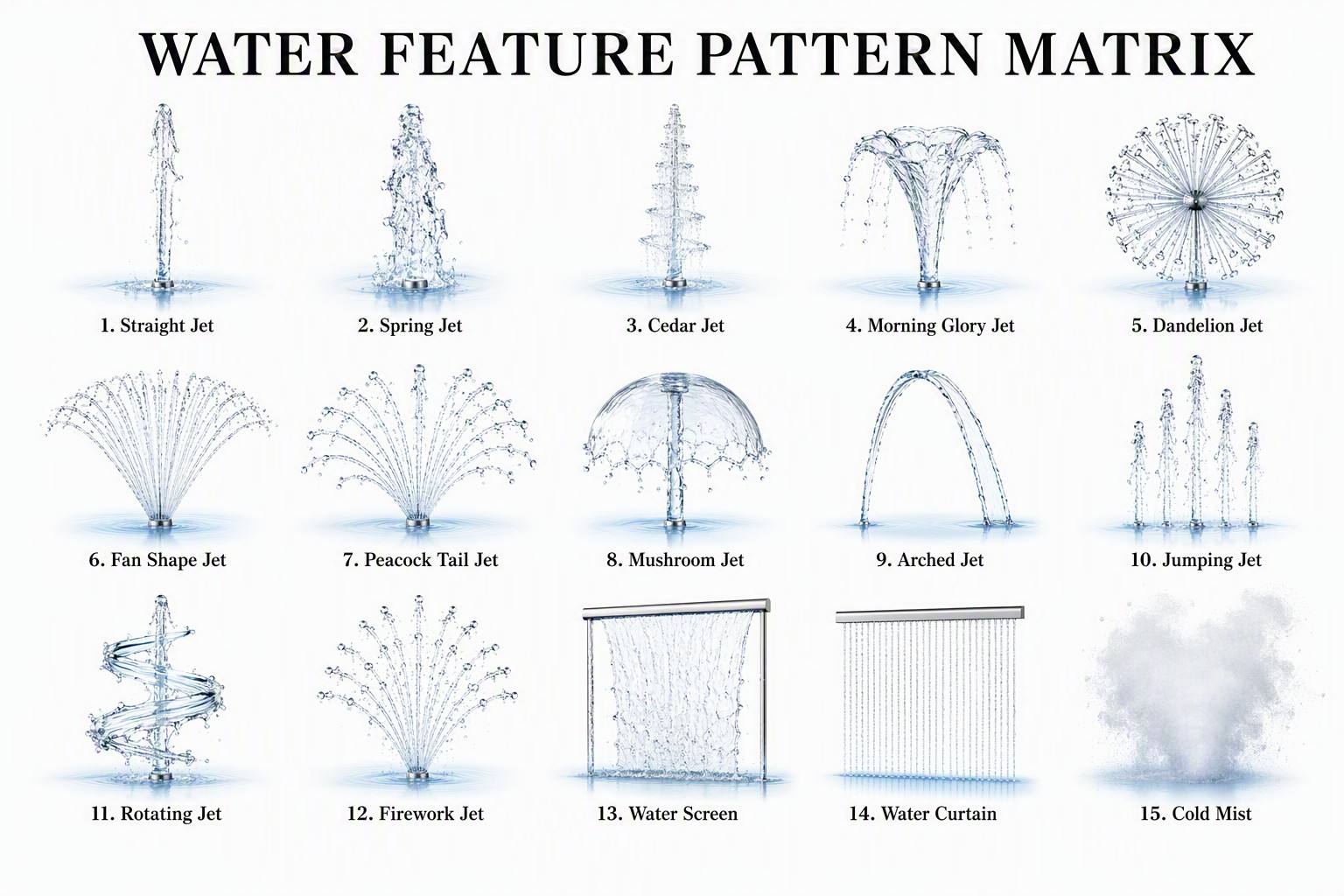
1. Straight Jet (Central Vertical Jet) Water Pattern
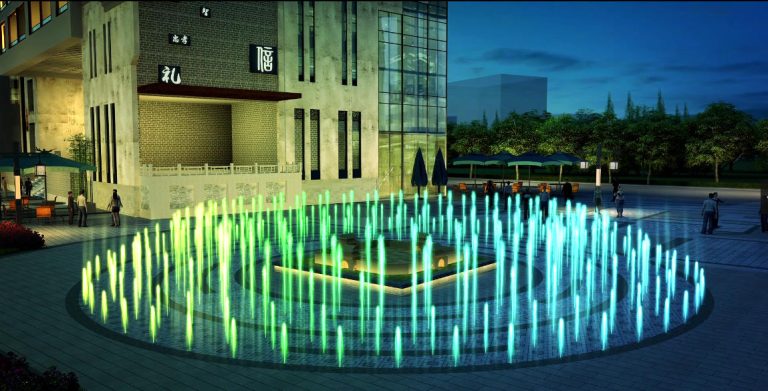
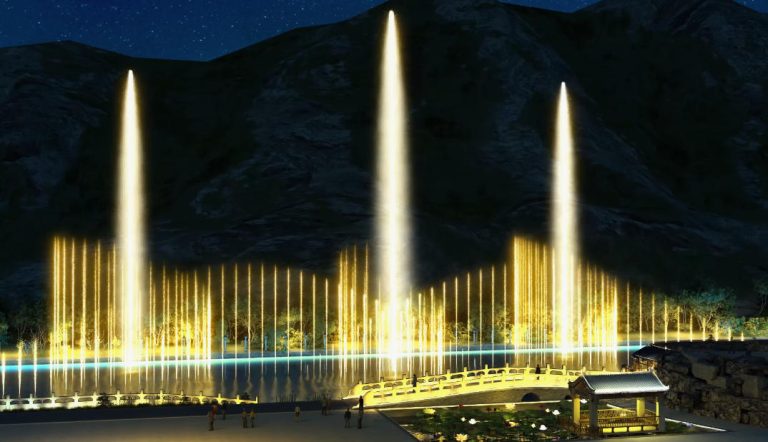
The straight jet is the most fundamental and classic fountain water pattern. Water columns are ejected vertically upward and concentrated by nozzles, forming upright, powerful streams. Depending on nozzle bore size and water supply volume, jet heights range from dozens of centimeters to over one hundred meters.
Design Notes: Straight jet nozzles demand relatively high water quality; impurities tend to clog orifices. They are commonly deployed as main water columns, paired with decorative surrounding patterns to form a layered layout: central high jets + peripheral low jets. The main jet of a large musical fountain usually serves as the visual focal point of the entire water feature.
Application Scenarios: Central main jets for plazas, water features in front of monuments, central high jets on large lake surfaces.
2. Geyser Water Pattern
The geyser pattern simulates the surging effect of natural springs. Water wells up from the pool bottom under low pressure, generating continuous churning ripples on the water surface without distinct tall water columns. Its visual effect is natural and soft, widely used to create an ecological atmosphere.
Design Notes: Precise control over surface water fluctuation is required for geysers, often paired with overflow weirs or wave suppression structures. Suitable for shallow water areas with a typical water depth not exceeding 30 cm.
Application Scenarios: Natural-style landscape water features, wetland parks, ecological restoration water bodies.
3. Cedar Tree Water Pattern
Using specially designed cedar nozzles, this pattern sprays water upward while spreading outward, forming layered shapes resembling cedar branches. The dense, full spray delivers strong visual volume, making it one of the most frequently adopted decorative fountain patterns.
Design Notes: Cedar nozzles are available in fixed and adjustable types. Adjustable cedar nozzles allow modification of spray angles for flexible flow configurations. When multiple cedar nozzles are arranged, the spacing must exceed the spreading radius of the water pattern to avoid mutual interference.
Application Scenarios: Lake fountains in parks, atriums of commercial plazas, residential community water features.
4. Morning Glory Water Pattern
Also known as trumpet flower pattern. The morning glory nozzle ejects water upward, which expands into a trumpet shape with smooth, elegant flow mimicking blooming morning glories. The overall silhouette is graceful with fine water sprays.
Design Notes: This pattern requires stable water pressure; pressure fluctuations will deform the flower shape. Installation of pressure stabilizers or variable frequency pump control is recommended. Single morning glory units typically have a height of 1–3 meters.
Application Scenarios: Landscape ponds, residential water features, indoor water features in hotel lobbies.
5. Dandelion Water Pattern
Realized by a spherical multi-orifice nozzle. Dozens of tiny jets radiate evenly from the sphere surface to form a spherical cluster of sprays, resembling a dandelion from afar. It boasts an exquisite shape and high recognizability.
Design Notes: Dandelion nozzles shall be installed horizontally to ensure uniform water pressure distribution across all outlets. Strict water filtration is necessary; a precision filter is recommended upstream. This pattern works best as an accent element and is not suitable for large-area layout.
Application Scenarios: Dry fountains, indoor water features, embellishments for small landscape spots.
6. Fan Jet Water Pattern
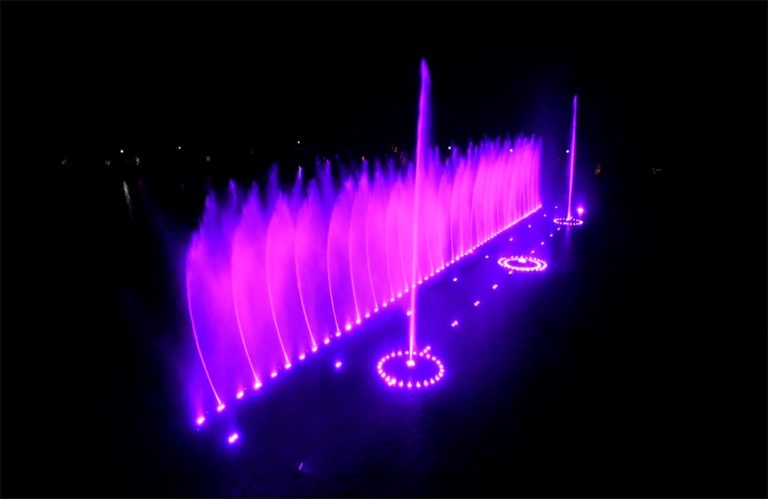
Fan nozzles spread water into fan-shaped sheets with a broad, expansive visual effect. A single row of fan jets creates a continuous fan wall, while multiple rows generate vertical depth. It is a widely used base pattern for large-scale fountains.
Design Notes: Fan nozzles support adjustable spreading angles ranging from 30° to 90°. When multiple fan nozzles are installed side-by-side, overlapping coverage angles must be calculated to ensure seamless splicing of fan surfaces.
Application Scenarios: Base water patterns along plaza frontages, plazas in front of buildings, outer zones of large fountains.
7. Peacock Tail Water Pattern
An advanced combined variant of the fan jet pattern. Groups of fan nozzles are arranged symmetrically on both sides of a central axis. When activated simultaneously, the whole formation resembles a peacock spreading its tail, presenting a magnificent grand effect, often used as the signature pattern of large fountains.
Design Notes: The peacock tail requires ample horizontal space; single sets normally span 5–15 meters in width. Symmetry is critical: nozzle models and water pressure on both sides must be strictly identical.
Application Scenarios: Large urban plazas, scenic area entrances, landmark water feature projects.
8. Mushroom Water Pattern
Mushroom nozzles shape water into full hemispherical streams with a rounded outline like a mushroom. The compact, lovely silhouette fits small water features and interactive zones.
Design Notes: Mushroom jets generally range 0.5–1.5 m in height and are unsuitable for high-jet applications. Nozzles must be mounted below the water surface to maintain intact hemispherical formation.
Application Scenarios: Small landscape ponds, children’s interactive water features, decorative accents for dry fountains.
9. Arch (Rainbow) Water Pattern
Directional nozzles propel water along parabolic trajectories to form arched water gateways. Arrays of arch nozzles create continuous arch passages that pedestrians can walk through, offering high interactivity. Sunlight refracting through the water arcs often produces rainbows, hence the alternative name rainbow pattern.
Design Notes: The parabolic trajectory is determined jointly by nozzle angle and water pressure. Precise calculation of water landing points is required to prevent splashing outside the pool. Multiple aligned arches must maintain consistent parabola heights.
Application Scenarios: Park walkways, arch gateways at landscape entrances, interactive water features.
10. Jumping Jet (Running Jet) Water Pattern
One of the most playful patterns for musical and interactive fountains. Multiple straight jets fire sequentially under program control. Water columns appear to hop and race across the ground, delivering dynamic chasing and running effects.
Design Notes: Jumping jets rely on DMX or PLC control systems for precise timing. More nozzles extend the jumping path and enrich visual effects; typical configurations consist of groups of 8–32 nozzles. Response speed is a key indicator; solenoid valve switching time should be less than 50 ms.
Application Scenarios: Dry fountains, interactive water features, dynamic segments of musical fountain performances.
11. Rotating Jet Water Pattern
Rotating nozzles or mechanical rotary units spin water columns during ejection to form spiraling upward motion. The jet trajectory resembles a DNA double helix with strong dynamic appeal.
Design Notes: Rotating jets are divided into hydraulically driven and motor-driven types. Hydraulic rotation requires no extra power yet offers uncontrollable speed; motor-driven rotation enables precise speed adjustment and is preferred for programmed musical fountains.
Application Scenarios: Dynamic segments of musical fountains, stage water features, landmark water installations.
12. Firework Jet Water Pattern
Specially designed firework nozzles disperse water outward once jets reach maximum height, simulating bursting fireworks with powerful visual impact. Frequently deployed in climactic musical fountain sequences to lift the atmosphere in rhythm with music.
Design Notes: The bursting effect of firework nozzles depends on accurate water pressure regulation. Insufficient pressure fails to create bursts, while excessive pressure causes excessive splashing. Variable frequency pumps are recommended for dynamic adjustment.
Application Scenarios: Climax segments of musical fountain shows, festival water performances, large-scale light & water shows.
13. Water Screen Pattern
Water screen generators discharge continuous sheet-like water cascading down from an elevation to form flat vertical water walls. The smooth, uniform water surface serves as a projection medium for water screen movies and laser projection, constituting a core element of night tourism and water light shows.
Design Notes: Water screen flatness and uniformity directly determine projection clarity. Generators must deliver even outlet gaps and stable, sufficient water flow. Typical water screen heights range from 5–20 meters, with widths customized per projection requirements. Laser or high-definition projector matching needs consideration of projection distance and brightness.
Application Scenarios: Water screen movies, night light shows, cultural tourism night projects, grand celebration water features.
14. Water Curtain Pattern
Water curtain nozzles or multi-row perforated pipes release parallel vertical thin streams to form curtain effects. Unlike the sheet flow of water screens, water curtains consist of discrete vertical streams. Scenery behind can be partially seen through the gaps, delivering enhanced depth.
Design Notes: Curtain density depends on stream spacing and quantity. Wind impact must be considered for outdoor installations, and wind shielding measures should be provided. Lighting behind the curtain can create striking light curtain effects.
Application Scenarios: Water curtain walls at building entrances, landscape partitions, indoor decorative water features.
15. Mist (Cold Fog) Water Pattern
High-pressure mist systems pressurize water to dozens of bar. Precision nozzles atomize water into micron-sized droplets to form pervasive fog. This pattern creates no prominent water columns and focuses on atmosphere building; paired with lighting, it generates fairyland-like visuals.
Design Notes: Mist systems require extremely high water quality. Multi-stage filtration is mandatory to prevent nozzle clogging. High-pressure pipelines and joints need regular inspection. Mist density and coverage are determined by nozzle layout density and installation height. Cold fog systems do not raise ambient temperature and are ideal for summer use.
Application Scenarios: Atmosphere creation for night lighting, artistic conception water features, theme park fog forest systems, auxiliary effects for dry fountains.