Key Elements of Professional Water Screen Projection Show Design
Clients often ask: “Isn’t a water screen show just a large projector, a water screen, and a video on loop?” But actual projects are far more complex—and far more fascinating—than one might imagine.
A water screen show is a precision-coordinated performance system in which five key components—creative content, projection, fountain equipment, control systems, and venue conditions—must be synchronized in real time. If any one element falls out of sync, the overall viewing experience will be significantly diminished.
We do more than just provide equipment installation services; we craft a complete, immersive sensory narrative experience.
01 Creative Planning
Establish the Story First, Then Discuss the Equipment
Every spectacular performance begins with a narrative framework, not a list of equipment specifications. We prioritize composing the soundtrack, and the rhythm of all visual sequences is synchronized with the music. The storyboard serves as the master timeline: fountain choreographers, lighting designers, projection technicians, and laser programmers all collaborate based on this frame-by-frame standard. Without this foundational design, the final result would be nothing more than a video played on a water screen.
02 Projection System
A Flowing “Screen”
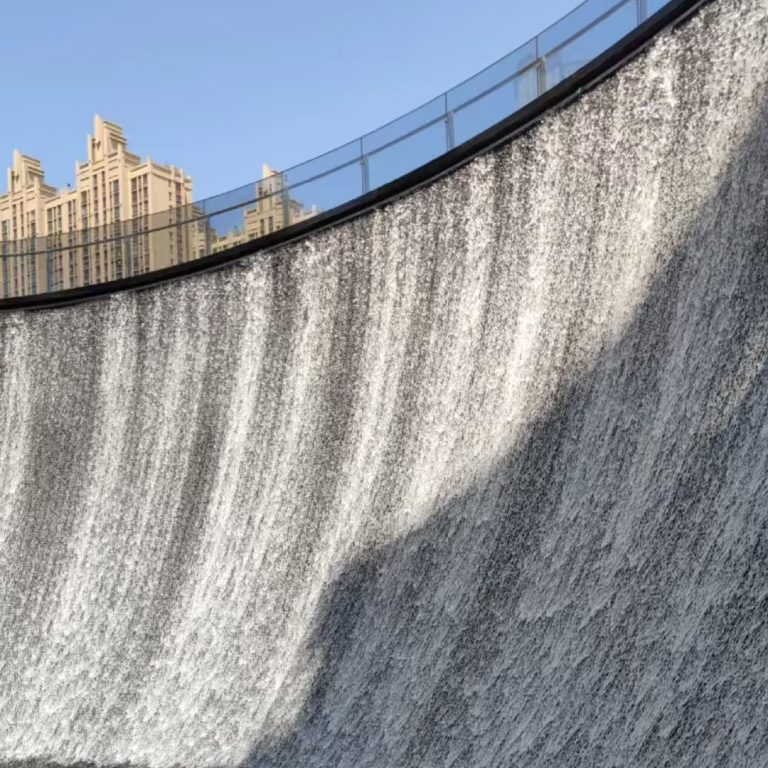
The shape of the water screen directly determines image quality. A fan-shaped water screen is suitable for wide-scale storytelling; a circular water screen creates an immersive, surround-sound effect; and a vertical water screen is suited for narrow, elongated water bodies. The base brightness for outdoor projection must not be less than 15,000 lumens; the main water screen is equipped with a laser light source as standard, requiring a brightness of 25,000–40,000 lumens. Large-scale performance projects require an array of 3–6 projectors to achieve a seamless image through edge blending. Integrating 3D architectural light mapping with the water screen is key to creating distinctive performance effects.
03 Fountain System
Dynamic performers, not static backdrops
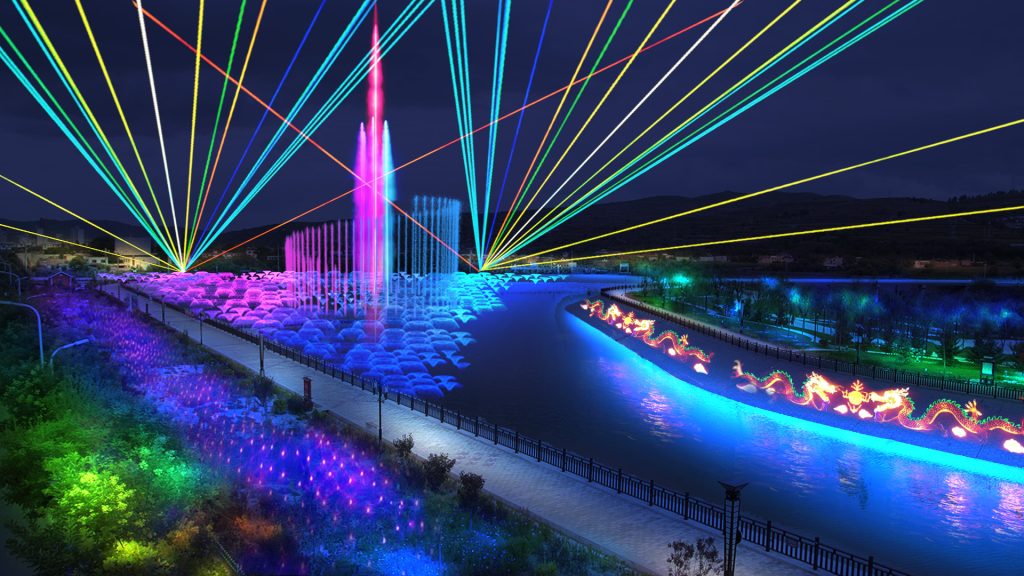
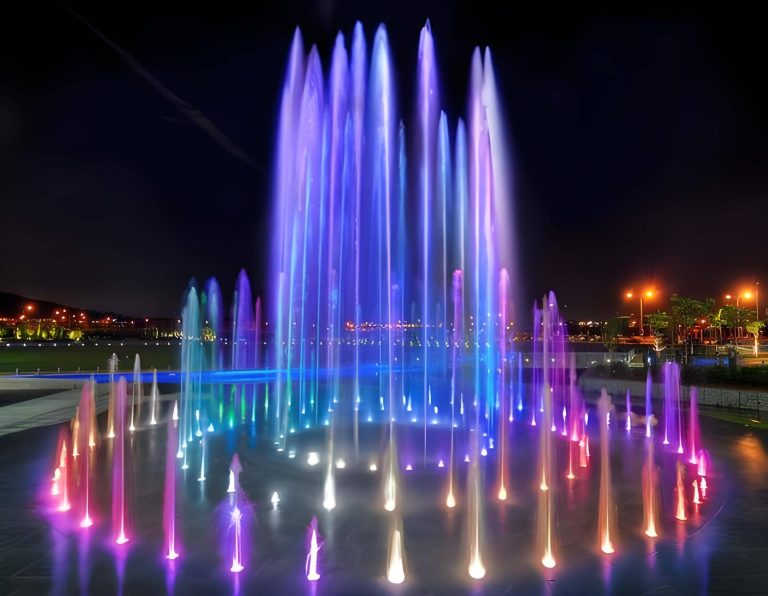
This is our core strength. Programmable one-dimensional nozzles can trace smooth water lines; two-dimensional nozzles can shape three-dimensional, dynamic water forms, and the choreography logic for the two is entirely different. Underwater LED lighting serves as the color foundation for the water feature; the color coordination between the lighting and the projected images must be finalized during the preliminary planning phase and cannot be left to ad-hoc adjustments on-site. Air-burst water sprays create dramatic turning points, flame effects heighten the climax, and cold fog sets the atmospheric tone. Precise timing of special effects is far more important than simply piling on a large number of them.
04 Control System
The Metronome of the Entire Performance
SMPTE timecode serves as the core reference for the entire performance: fountains, lighting, projections, lasers, and audio are all synchronized to the same master clock signal. DMX512 manages the lighting system, Art-Net handles network signal transmission, and PLC ensures safety logic—these three independent control chains each fulfill their specific functions. Redundant backup for the main controller is a mandatory requirement: should the primary controller fail, the backup system must take over seamlessly. Even a signal interruption as brief as 0.1 seconds would be clearly noticeable to the audience.
05 Site Conditions
The Focus of 80% of Project Risks
Water depth, seasonal fluctuations in water levels, water turbidity, and winter freezing issues all constrain equipment selection and construction plans. Audience sightlines determine the placement of projectors; the projection path must not interfere with the audience’s line of sight. For open-water projects, acoustic simulations must be conducted; otherwise, audio dead zones may occur in certain viewing areas. In terms of power load, a medium-sized performance can consume 300–500 kilowatts of electricity. If this is not verified with the local power authority during the preliminary phase, it will be difficult to resolve the issue through emergency measures later on.