
Dry Fountain Design
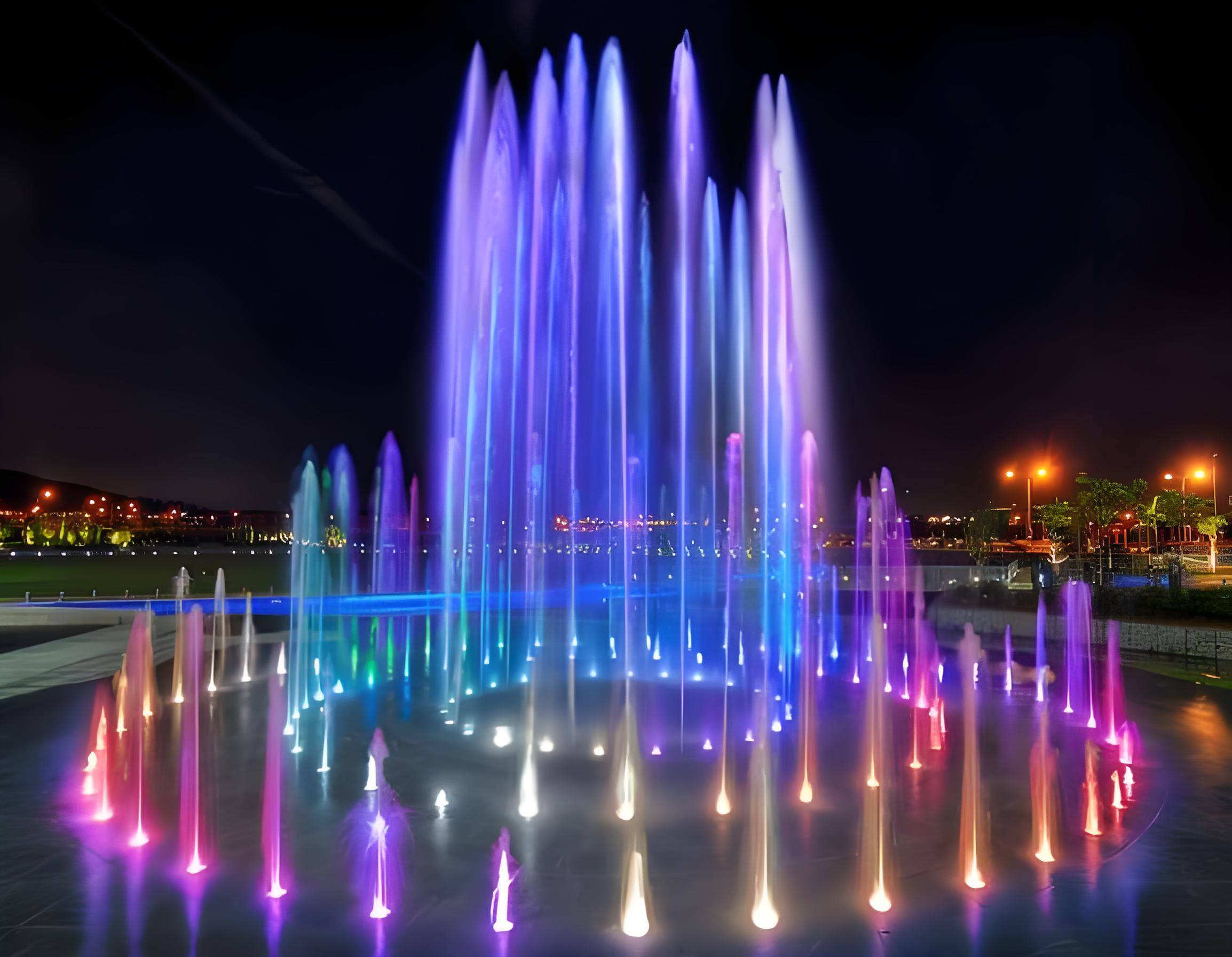
Dry fountains, also known as invisible fountains, feature no exposed water basins; the surface is walkable; all equipment is fully buried underground; they drain quickly; operate at low pressure for safety; and support interactive features. They are widely used in public spaces such as municipal plazas, commercial plazas, and recreational parks.
I. Preliminary Survey and Requirements Confirmation
1. Site Survey: Verify ground load-bearing capacity, foot traffic volume, ground levelness, and underground utilities to avoid construction conflicts.
2. Functional Definition: Determine modes such as standard landscape, music, motion sensing, and children’s interactive modes; confirm spray height, performance styles, and activation/deactivation methods (timed / sensor-activated / manual).
3. Parameter Confirmation: Standard spray height ≤ 1.5 m; confirm drainage slope, excavation depth, paving style, and winter freeze protection requirements.
4. Water and Electricity Verification: Confirm low-voltage power supply, grounding conditions, and the layout of water supply and drainage networks.
II. Concept and Layout Design
1. Overall Layout: Employ symmetrical, matrix, and curved designs to complement the plaza’s style. When the system is shut down, the ground remains completely level, ensuring unobstructed pedestrian traffic and full site usability.
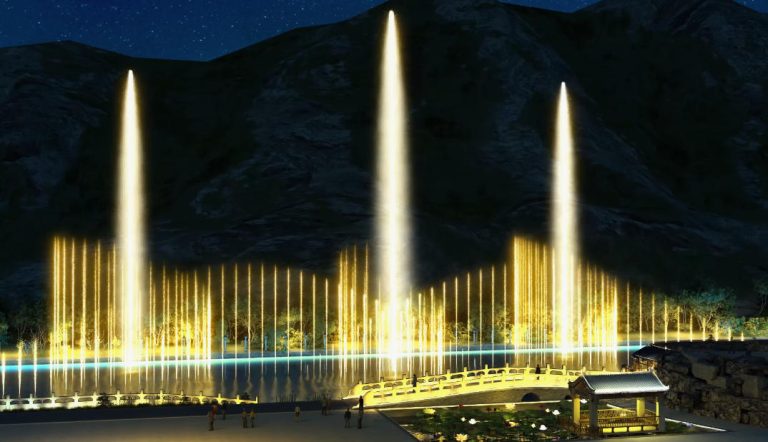
2. Water Feature Combinations: Select jumping fountains, rippling fountains, and steady-flow fountains; avoid large swinging features or extremely high water columns to effectively prevent water splashes from wetting pedestrians or causing disturbances to nearby residents.
3. Lighting Configuration: IP68-rated, pressure-resistant in-ground lights are installed to enable synchronized color changes between music, water patterns, and lighting, creating a rich nighttime visual experience.
4. Control System: Supports scheduled operation, music synchronization, and motion-sensor interaction, catering to diverse scenarios such as nighttime viewing and family-friendly activities.
5. Proposal Delivery: Provide floor plans, renderings, and performance proposals for client review and final approval.
III. Detailed Engineering Design
3.1 Excavation Pit and Waterproofing Structure Design
A closed underground water tank design is adopted, with the excavation pit depth controlled between 0.5–1.0 m; a drainage slope of ≥0.2% is provided at the pool bottom, utilizing multi-layer impermeable waterproofing techniques; dedicated access hatches and drainage outlets are provided to facilitate future operation and maintenance.
3.2 Rapid Drainage and Water Circulation System
The core advantage of a dry-land fountain: no standing water on the ground when the system is shut down. Equipped with a complete set of water collection, rapid drainage, overflow, and wastewater discharge systems, along with water recirculation, filtration, and algae-removal equipment, the system maintains consistently clear water quality and effectively prevents nozzle clogging.
3.3 Hydraulic Design and Equipment Selection
Professional in-ground pipeline pumps or in-pipe pumps are selected. Through precise zone-by-zone hydraulic calculations, flow rates and head are matched to the nozzles to ensure uniform and stable water discharge across the entire area; All underground piping is treated with anti-corrosion and anti-rust coatings to extend the equipment’s service life.
3.4 Electrical Safety Design
All underwater and underground equipment uses safe, low-voltage power supply; equipped with ground-fault circuit interrupters (GFCIs) and equipotential bonding systems, with all wiring fully sealed and waterproofed; safety protection measures are further reinforced in children’s interactive areas.
3.5 Paving and Finishing Design
Precise positioning of openings for spray nozzles and lighting fixtures ensures a level surface free of protrusions; all openings are sealed with waterproof material to prevent surface water from flowing back; paving materials meet standards for pedestrian load-bearing capacity, wear resistance, and all-weather use.
3.6 Winter Freeze Protection Design
Standard features include an automatic drainage system and low-level drain valves, which allow for complete drainage of standing water from pipes and foundation pits during winter, thoroughly preventing pipe and equipment damage from freezing and cracking, making the system suitable for use in cold-weather regions.
3.7 Construction Drawing Output
A complete set of professional construction drawings is provided, including: general site layout plan, nozzle and lighting fixture placement plan, foundation pit structural plan, electrical and plumbing schematic diagrams, paving cutout plan, equipment list, and civil engineering technical specifications.
IV. Equipment Customization and Procurement
We provide dedicated equipment for dry-land fountains: in-ground nozzles, pressure-resistant in-ground lights, pipeline pumps, water circulation and filtration equipment, variable-frequency control systems, music synchronization units, and motion-sensing controllers. All equipment undergoes comprehensive testing for water resistance, corrosion resistance, and pressure resistance before leaving the factory to ensure it meets quality standards.
V. On-Site Construction and Installation
Construction Process: Excavation and waterproofing of the foundation pit → Water tank construction → Pipe laying and pressure testing → Installation of underground equipment → Paving, cutting openings, and finishing → Waterproofing and wiring → Grounding protection
Construction Focus: 100% pressure testing of pipes with zero leaks, passing the foundation pit water-tightness test, precise and level ground surfaces, and fully sealed, waterproof joints at all connections—ensuring comprehensive construction quality.
VI. System Commissioning
1. Individual Unit Commissioning: Test pumps, spray nozzles, and lighting one by one to identify blockages, leaks, or equipment malfunctions, ensuring each unit operates normally.
2. Drainage Commissioning: Repeatedly test drainage performance to ensure accumulated water is rapidly drained after the system shuts down, leaving no residual water on the ground.
3. Integrated Commissioning: Precisely calibrate the synchronization of music, water patterns, and lighting rhythms, and standardize the spray height across the entire venue to ensure a consistent and uniform performance effect.
4. Interactive Testing: Optimize the sensitivity of the motion sensors to eliminate false triggers and operational lag, ensuring a smooth interactive experience.
VII. Trial Operation and Acceptance
Conduct a 72-hour continuous trial operation at full capacity to ensure stable equipment operation without leaks, overheating, or abnormal noise; optimize the overall performance effect; compile the complete set of completion documentation; finalize project handover; and provide professional hands-on training to operators.
VIII. Maintenance and After-Sales Service
Provide routine maintenance services, including filter cleaning, descaling and unclogging of nozzles, drainage system inspections, electrical safety checks, winter equipment drainage and freeze protection, and regular updates to fountain performance programs, to ensure the long-term stable operation of the equipment.