Analysis of Three Typical Water‑Screen Movies: Fan‑Shaped, Direct‑Flow Drainage and CNC Water Screens
A Comprehensive Analysis of the Three Common Types of Water Screen Movies: Fan-Shaped Water Screens, Direct-Flow Drainage Screens, and CNC Water Screens
Water screen movies are currently one of the most visually striking forms of presentation in musical fountain projects and are widely used in scenic area night tours, urban plazas, and cultural and tourism complexes. Many people assume that a water screen is simply a curtain of water used to project a movie; in reality, water screen movies can be divided into three mainstream types based on how the screen is formed: fan-shaped water screens, direct-flow drainage screens, and CNC-controlled water screens. Their visual effects and suitable applications vary significantly. Let’s break them down one by one.
I. Fan-Shaped Water Screen
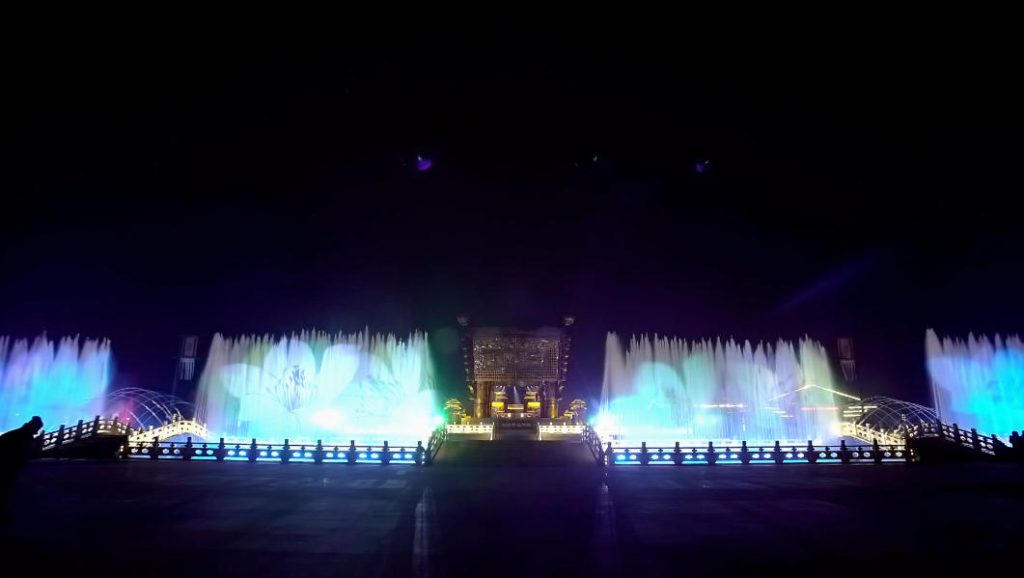
The fan-shaped water screen is the most widely used and technically mature type. High-pressure water jets are sprayed into the air in a fan-shaped pattern through fan-shaped nozzles, forming a water film tens of meters wide. Projectors project images onto this “water screen” from either the front or the back. Viewed from the side, the cross-section of the water screen unfolds like a fan—narrow at the bottom and wide at the top, resembling an open folding fan.
Key Features: Screen height ranges from 15 to 40 meters, with a width of 20 to 60 meters that can be customized as needed; the water film maintains good continuity and offers high projection clarity, making it suitable for video content; wind resistance is moderate (the screen surface is prone to dispersing in winds exceeding Force 3–4). Suitable Scenarios: Large open bodies of water—urban scenic lakes, scenic area reservoirs, coastal plazas, and live cultural and tourism performances—making it the preferred solution for water screen film projects in China.
II. Direct-Flow Water Screen
The direct-flow water screen does not rely on a water film for imaging. Instead, it features dozens or even hundreds of direct-flow nozzles densely arranged in a straight line, with each nozzle spraying a fine, dense column of water vertically upward to form a continuous “water wall” side by side. To put it simply: a fan-shaped water screen is like “a fan,” while a direct-flow water screen is like “a row of fences.”
Core Features: The screen surface is straight and uniform, with neat edges; Because it consists of independent water columns, the projected image exhibits a subtle vertical striped effect; it offers a unique aesthetic when displaying abstract light and shadow effects or laser animations, though its high-definition video reproduction quality is not as good as that of a fan-shaped water curtain; it has better wind resistance than a fan-shaped water curtain, requires less water flow, and has lower operating costs. Suitable Scenarios: Medium- to large-sized fountain basins, commercial plaza water features, and building forecourts; it is often combined with choreographed musical fountains to create synchronized water curtain and lighting performances.
III. Computer-Controlled Water Curtain
The computer-controlled water curtain is the most technologically advanced and expressive of the three types. Each nozzle is precisely controlled by an independent solenoid valve with millisecond-level accuracy; through programming, it can “write” text, patterns, logos, and even simple animations within the water curtain. If the fan-shaped water curtain is a “projector” and the direct-flow water curtain is a “light show,” then the computer-controlled water curtain is a “water-based LED screen”— —it creates images through the presence or absence of water, enabling independent performances without the need for a projector.
Key Features: Resolution is determined by the spacing between nozzles (typically 20–50 mm, with high-end systems reaching 10–15 mm); it can display Chinese and English text, numbers, and graphics, with text cascading from the top of the curtain to create a waterfall-style effect; construction and maintenance costs are higher than the other two types, and water quality requirements are stricter (to prevent nozzle clogging). Suitable Scenarios: Commercial complexes, brand launch events, theme parks, hotel water features, and Instagrammable hotspots—the “water that writes” naturally generates buzz.
IV. How to Choose?
The three types of water screens aren’t a matter of superiority or inferiority, but rather a question of suitability for the scenario:
Seeking grand scale and visual impact → Fan-shaped water screen. The “standard configuration” for large-scale lake performances, offering a vast display area and high clarity.
Limited budget, wind resistance required → Direct-flow water curtain. Cost-effective with low operational and maintenance costs; creates outstanding light and shadow effects when paired with lighting.
Emphasis on interaction and virality → Computer-controlled water curtain. “Writing on water” naturally generates buzz, making it ideal for commercial spaces and brand marketing.
Seeking the ultimate experience → A combination of all three. Fan-shaped water curtain for video playback + computer-controlled water curtain for text display + direct-flow water curtain for ambiance—creating a richly layered experience.