
How to Choose a Musical Fountain Manufacturer
Musical fountains are one of the few types of purchases where “the pitfalls are already in place before you’ve even spent a dime”—you’re not buying a ready-made product, but rather commissioning a manufacturer to design, produce, program, ship, and install it for you, and to ensure it works properly for several years.
Choose the right manufacturer, and the entire project will go so smoothly it’s almost boring: on time, on budget, and still running normally ten years later.
I. Is It a Manufacturer or a Middleman?
The first thing to clarify: Are you dealing with a manufacturer or a trading company?
Trading companies have no factories, no engineering teams, and no control over quality. They take your deposit, outsource the work to the lowest bidder, mark up the price, and spend the rest of their time forwarding emails. When the pump breaks down and you call them, you’ll be speaking to someone who’s never even held a wrench.
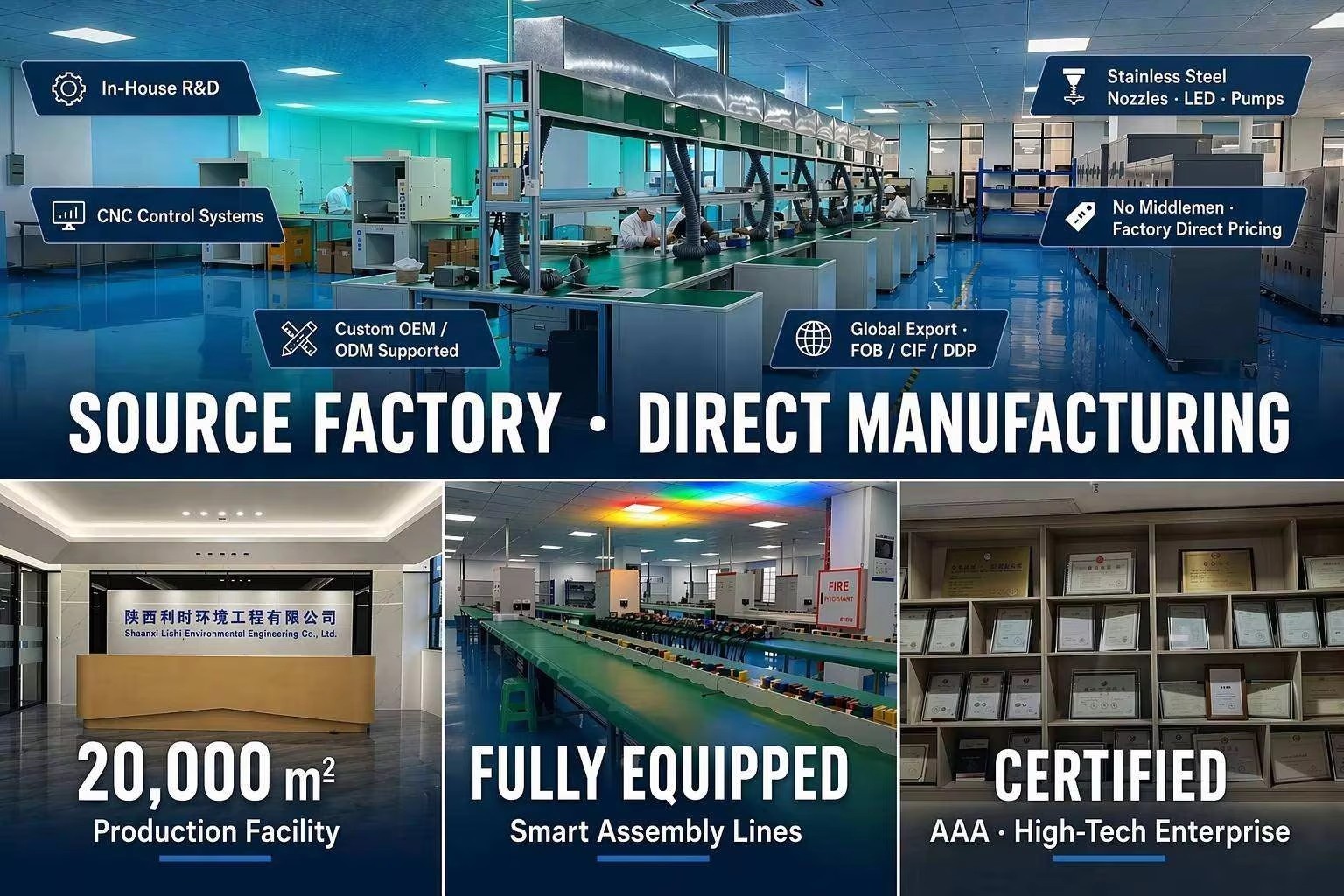
A genuine source factory handles design, machining, assembly, and testing entirely in-house. The benefits are tangible:
You can work directly with the engineers who actually build the equipment.
Quality inspections are conducted at every stage—not just spot checks after the goods arrive.
The warranty is backed by the people who actually manufacture the product.
There are no middleman markups.
How to verify: Ask them to send a live video of the factory workshop, photos of the production line, and a business license showing export qualifications. A genuine manufacturer will send these to you within a day, while middlemen will keep stalling.
II. Certifications and Compliance
Musical fountains are electrically powered devices submerged in water, so compliance requirements are very high—especially if you plan to import into the EU or North American markets.
Check whether the manufacturer can provide:
CE certification (EMC) for the electrical components
IP68 waterproof rating covering submersible pumps and underwater lights
Any other regional certifications required by your target market
Certifications aren’t just for show. They provide you with legal protection in case of problems and serve as the fastest way to weed out “OEM middlemen”—those who merely slap logos on brochures and can be spotted at a glance.
III. Control System Technology
The control system is the fountain’s brain; it determines whether your fountain truly “dances to the music” or merely sprays water on a timer.
These are two fundamentally different technical approaches that cannot be used interchangeably:
Comparison Criteria DMX Control System Traditional PLC Control
Music Synchronization Accuracy Millisecond-level, frame-by-frame synchronization Second-level, threshold-triggered
Programming Method Timeline editing, WYSIWYG Ladder diagram programming, long debugging cycle
Scalability Modular, add or remove points at any time Limited by the number of physical I/O points
Maintenance Remote diagnostics, firmware updates Requires on-site technicians
Suitable Applications Musical fountains, integrated sound-light-and-water effects Simple循环 water features
For musical fountains, DMX is the industry standard. Manufacturers still heavily promoting PLCs are either selling you something that isn’t a musical fountain at all—just a water feature—or are still using technology from a decade ago. Neither of these is what you want.
IV. Modular Product Design
Traditional fountains are “one-time deals”: dig the pool, bury the pipes, install the equipment—and once it’s done, it can’t be changed. When you want to switch programs, you have to tear it all down and start over.
Modular fountains turn pumps, nozzles, lights, and control nodes into standardized, interchangeable building blocks. The benefits are immediate:
If something breaks, just replace the single module—no need to shut down the entire system
To change a show, you only need to modify the program—no hardware changes required
The entire system can be relocated and reused during site renovations
Ask this directly: “Are all your modules pre-assembled and pre-tested at the factory before shipment?” A reputable manufacturer will answer with a straightforward “Yes”—without hesitation.
V. Verifiable Case Studies
Anyone can post numbers like “1,000+ projects” on their website. If it can’t be verified, it’s zero.
Ask them to provide evidence:
Photos and videos of completed projects—not 3D renderings
Client references you can contact directly
Case studies in your region, or at least in your specific climate conditions
Manufacturers who’ve installed hundreds of musical fountains have already encountered every pitfall you can’t even imagine. This experience is the difference between “smooth acceptance in two weeks” and “endless troubleshooting for half a year.”
VI. One Team Handles Everything from Design to Maintenance
This is the aspect most easily overlooked, yet it quietly determines the project’s success or failure. Some companies only handle design, some only construction, and some only installation—very few can handle all three in-house.
Once design, construction, and commissioning are split among multiple companies, every handoff becomes a leak in the budget: responsibility gets passed back and forth, and the schedule gets delayed time and time again.
A full-chain team (design + construction + installation + maintenance—all handled by a single provider from start to finish) offers you a straightforward solution:
There is only one party to hold accountable for the entire project.
The design intent is carried through unchanged from the blueprints all the way to commissioning.
When problems arise, the response is swift because the same team of engineers is still on the job.