
How to Design a Water Curtain?
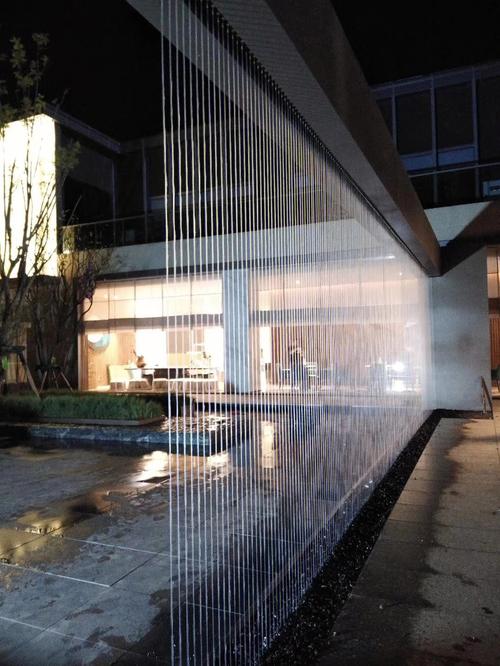
Water curtains are a classic water feature that enhances the ambiance of a space and are widely used in hotel lobbies, commercial atriums, corporate exhibition halls, and private gardens. The key to their design lies in ensuring that the water flows down evenly, quietly, and in a controlled manner.
I. Choosing the Right Type
Overflow Trough Style: Water overflows from a top trough and flows down the facade—the most classic design, suitable for both indoor and outdoor use.
Linear Curtain Style: Water falls vertically from openings without touching the surface, creating a strong sense of transparency; ideal for lobbies and exhibition halls.
Fiber-Optic / Digital Water Curtain: Capable of changing colors or displaying patterns; suitable for commercial and entertainment spaces.
The overflow trough style is the top choice for indoor settings due to its low noise level and simple maintenance.
II. Four Key Parameters
| Parameter | Recommended Value | Notes |
| Water Film Thickness | 2–5 mm | Too thin causes the flow to break; too thick causes splashing |
| Water Flow Velocity | 0.3–0.8 m/s | Too fast causes excessive noise; too slow results in an intermittent flow |
| Overflow Outlet Flatness | Within ±1 mm | If not level, the water flow will be skewed |
| Wall Inclination | 3°–5° (slight slope) | Reduces water splashing |
III. Materials and Structure
Water-bearing Surface: Ultra-clear tempered glass (transparent), stainless steel sheet (modern), natural stone (natural)
Overflow Channel: 304/316 stainless steel, with precision-milled edges at the channel opening; equipped with adjustable feet for leveling
Drainage Channel: ≥200 mm wider than the water-bearing surface; covered with a grating to prevent splashing; filled with river pebbles to dissipate energy and reduce noise
Waterproofing: A complete waterproof layer is applied to the interior back panel; a 50–100 mm ventilation gap is left between the wall and the water curtain
IV. Water Circulation System
Pump: Low-noise centrifugal pump mounted on a vibration-damping foundation, with flexible connections at the inlet and outlet
Filtration: Hair filter + 50–100 mesh bag filter to prevent clogging of the overflow outlet
Water Tank: Capacity of 3–5 times the circulating water volume, equipped with automatic water replenishment, overflow, and drainage
Disinfection: Indoor UV disinfection to suppress algae and odors
Freeze Protection: Outdoor piping insulated with heating cables or designed for winter drainage
V. Lighting and Noise Reduction
Lighting: Concealed LED underwater lights (IP68) at the bottom, illuminating upward; 3000K warm white for a premium look; RGB for dynamic effects
Noise Reduction: Energy-dissipating layer in the water collection trough + pump sound insulation + piping designed to avoid right-angle bends + bottom water-guiding channels
VI. Key Points to Avoid Pitfalls
1. The overflow outlet must be leveled—use a level to calibrate each section during installation
2. Manage water quality—hard water causes scaling, and stagnant water promotes algae growth; plan filtration and disinfection in advance
3. Allow for maintenance access—the pump, filter, and overflow channel must all have accessible covers for maintenance
4. Estimate noise levels in advance—for indoor projects, pay special attention to controlling pump and drainage noise
VII. Design Process
Determine requirements → Select and finalize models → Hydraulic calculations → Structural design → System integration → Construction and installation → Commissioning and maintenance